Eleanor was born on 28 December 2021 and sadly died at Alder Hey Children’s Hospital on 2 October 2023, when she was just 21 months old.
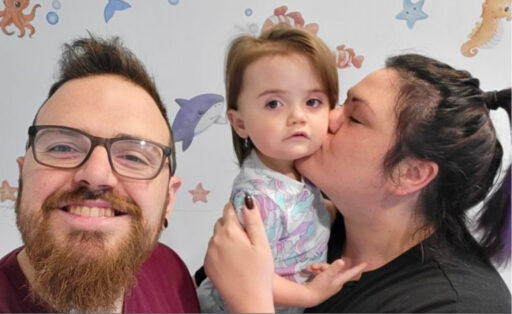
[Photo of Eleanor with her parents, Charles and Rachel]
Eleanor had been diagnosed with bicoronal craniosynostosis (a birth defect where the two coronal sutures—the fibrous joints running from ear to ear across the top of the skull—fuse together too early) when she was around 12 weeks old. Eleanor underwent surgery to address the craniosynostosis on 29 September 2023.
After surgery, Eleanor showed signs that she was not well, including a raised heart rate and a need for oxygen. Her parents were worried about her breathing and heart rate while she was on the ward.
A chest x-ray was later taken and was grossly abnormal, showing a tension pneumothorax (where air gets trapped in the chest cavity), but this was not escalated to the ward in time.
Eleanor suffered a cardiac arrest before the pneumothorax was identified and treated. A later brain scan confirmed that she had suffered an unsurvivable brain injury caused by the prolonged cardiac arrest. Eleanor died in her parents’ arms on 2 October 2023.
Alder Hey carried out an internal investigation into Eleanor’s death. The review identified numerous failures in her care, including failures in PEWS scoring, escalation, oxygen use and recognition of the abnormal x-ray. The Trust accepted that Eleanor’s death was preventable.
Inquest into Eleanor’s death
An inquest was opened to examine how Eleanor died. Our clinical negligence team provided representation to the family at the Inquest which resulted in the Coroner concluding that Eleanor’s death was misadventure contributed to by neglect.
Following the outcome of the inquest, a Letter of Claim was sent to the Trust in January 2025. A response was received in May 2025 and liability was admitted. The case subsequently settled at mediation.
The Trust agreed to make a formal public apology.
Changes made by the Trust
Since Eleanor’s death, the Trust has made changes to a number of areas, including handover, escalation and discharge in theatre recovery; blood gas training; oxygen and high flow oxygen policies; recording parental and nursing concerns within PEWS; Martha’s Rule; out of hours medical provision; radiology escalation; resuscitation training; guidance on clinical deterioration; and consent pathways for craniofacial surgery.
The Trust has also agreed that the theatre recovery checklist and the radiography escalation process, both introduced after Eleanor’s death, will be named in Eleanor’s honour.
Legal representation
The family were represented by Lynda Reynolds, Partner, and Fran Moore, Senior Associate, in our Clinical Negligence team. Counsel instructed was Elliot Clifton Thompson, No.5 Chambers and Edward Ramsay, 12KBW
Fran Moore said:
‘This is an unimaginably tragic case. The number of basic errors in Eleanor’s care are hard to read. The tragedy is that minutes would have made the difference. The tension pneumothorax could have been treated before Eleanor’s cardiac arrest and, on the evidence, she would have recovered. It was identified too late, after she had been on the ward for several hours struggling to breathe.
For Eleanor’s family, the Trust’s acceptance of responsibility and public apology are important, but this follows a long and painful process.
Eleanor’s parents have spoken with great honesty about the guilt, distress and trauma they continue to carry. They have shown enormous strength and dignity throughout. Their focus has always been on understanding what happened and making sure the lessons are properly learned in Eleanor’s memory. We hope that the changes the Trust have implemented continue to make care safer for other children.”